
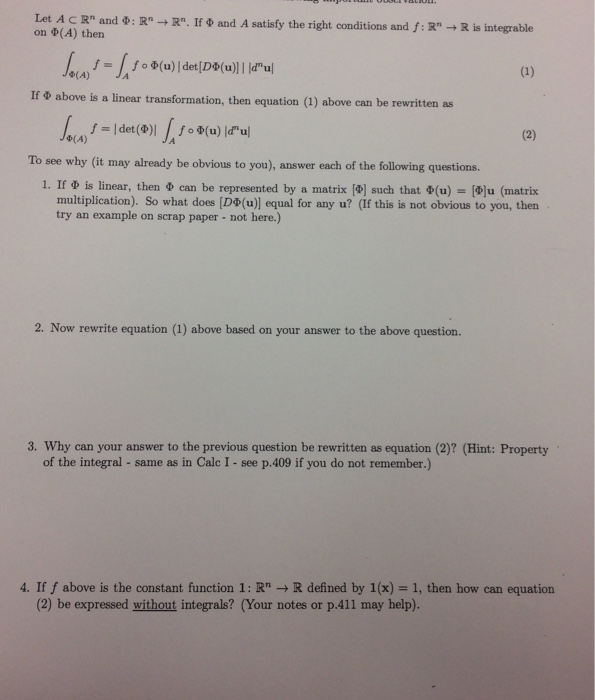
Show transcribed image text Let A c Rn and Φ: Rn → Rn. If Φ and A satisfy the right conditions and f: Rn → R is integrable on Φ(A) then If Φ above is a linear transformation, then equation (1) above can be rewritten as o(A) To see why (it may already be obvious to you), answer each of the following questions. 1. If Φ is linear, then Φ can be represented by a matrix [히 such that φ(u)-(blu (matrix multiplication). So what does [D(u)] equal for any u? (If this is not obvious to you, then try an example on scrap paper – not here.) 2. Now rewrite equation (1) above based on your answer to the above question. 3. Why can your answer to the previous question be rewritten as equation (2)? (Hint: Property of the integral – same as in Calc I-see p.409 if you do not remember.) 4. Iff above is the constant function 1: Rn → R defined by 1(x) = 1, then how can equation (2) be expressed without integrals? (Your notes or p.411 may help).
Let A c Rn and Φ: Rn → Rn. If Φ and A satisfy the right conditions and f: Rn → R is integrable on Φ(A) then If Φ above is a linear transformation, then equation (1) above can be rewritten as o(A) To see why (it may already be obvious to you), answer each of the following questions. 1. If Φ is linear, then Φ can be represented by a matrix [히 such that φ(u)-(blu (matrix multiplication). So what does [D(u)] equal for any u? (If this is not obvious to you, then try an example on scrap paper – not here.) 2. Now rewrite equation (1) above based on your answer to the above question. 3. Why can your answer to the previous question be rewritten as equation (2)? (Hint: Property of the integral – same as in Calc I-see p.409 if you do not remember.) 4. Iff above is the constant function 1: Rn → R defined by 1(x) = 1, then how can equation (2) be expressed without integrals? (Your notes or p.411 may help).